
Python vs Go for Backend: A Decision Framework Beyond Performance Benchmarks
You’ve seen the benchmarks showing Go is faster than Python. You’ve read that Python has better libraries. But when your team is staring at a greenfield backend project with a six-month deadline, neither fact tells you which language will actually get you to production successfully.
The standard comparison focuses on what’s easy to measure: request latency, throughput under load, memory footprint. These metrics matter, but they answer the wrong question. The right question isn’t “which language performs better in isolation?” It’s “which language lets this specific team ship this specific product with acceptable performance and manageable operational overhead?”
I’ve watched teams choose Go for its performance characteristics, then spend three months rebuilding basic functionality that Python’s ecosystem provides out of the box. I’ve also seen Python codebases that started lean and productive gradually collapse under scaling pressure, requiring expensive rewrites precisely when the business could least afford the distraction. Both decisions were defensible on paper. Both became costly mistakes because they optimized for the wrong variables.
The choice between Python and Go is fundamentally about matching language characteristics to your constraints: team expertise and hiring pipeline, product maturity and iteration speed requirements, operational complexity tolerance, and the actual performance envelope your product needs to operate within. Get this matching right, and either language works. Get it wrong, and no amount of raw performance or library richness compensates for the mismatch.
The real decision variables aren’t about the languages themselves. They’re about your team, your timeline, and the specific pressures your backend will face in production.
The Real Decision Variables: Beyond Speed and Syntax
When engineers debate Python versus Go for backend development, the conversation inevitably gravitates toward execution speed. Benchmarks get shared, microtests get dissected, and someone inevitably mentions that Go’s goroutines handle 10,000 concurrent connections while Python’s asyncio struggles with scale. This framing misses the actual decision that matters.
The I/O Bound Reality
Most backend services spend their time waiting. Waiting for database queries to return. Waiting for HTTP responses from third-party APIs. Waiting for cache lookups, message queue acknowledgments, and file system operations. A service that spends 95% of its time blocked on network I/O gains nothing from Go’s superior CPU performance. The bottleneck isn’t your language runtime—it’s your Postgres query plan or the latency to your payment processor’s API.
The performance narrative collapses further when you consider horizontal scaling. Adding three more containers to your Kubernetes cluster solves throughput problems that language-level optimizations never touch. The engineering cost of rewriting 50,000 lines of Python in Go vastly exceeds the AWS bill for extra compute resources.
Developer Velocity as a Cost Center
Runtime efficiency represents one variable in a multi-dimensional equation. Developer velocity represents another, often more expensive one. A senior Python engineer ships features in Django in hours that would take days in Go’s standard library ecosystem. This isn’t a skill gap—it’s the accumulated leverage of 15 years of Django’s ORM, admin interface, middleware stack, and third-party package ecosystem.
When your startup needs to validate a business model in three months, or your enterprise team faces a regulatory deadline, the language that ships working code fastest wins. The performance you might gain from Go becomes irrelevant if you don’t reach product-market fit before your runway ends.
Team Composition Trumps Technical Specs
Your team’s existing expertise matters more than language features. A team of three Python engineers with deep Django knowledge will outperform a team learning Go from scratch, regardless of Go’s theoretical advantages. The hidden costs appear in longer PR review cycles, more production bugs from unfamiliarity, and the opportunity cost of senior engineers reading documentation instead of solving business problems.
Conversely, if you’re building a team from scratch or hiring into a hot market, Go’s simpler syntax and smaller surface area can accelerate onboarding. A new graduate reads Go’s standard library in a week; Django’s ecosystem takes months to navigate effectively.
Lifecycle Stage Alignment
Early-stage products need iteration speed. Python’s REPL-driven development, dynamic typing, and rich library ecosystem optimize for rapid experimentation. Production-scale systems serving millions of requests benefit from Go’s compilation checks, explicit error handling, and predictable resource usage. The right choice depends on whether you’re validating assumptions or optimizing proven systems.
The concurrency story—often cited as Go’s killer feature—deserves deeper examination than benchmark charts provide.
Concurrency Models in Practice: Where Go Shines and Where It Doesn’t Matter
The concurrency story is where most developers start their comparison—and where most get it wrong. Yes, Go’s goroutines are lighter than OS threads. Yes, Python has the GIL. But these technical facts matter far less than when and how you’re handling concurrent operations.
Understanding the Real Bottleneck
In most backend systems, your application isn’t the bottleneck—your database is. When you’re spending 50-200ms waiting for Postgres to return query results, the difference between Go’s 2KB goroutine stack and Python’s thread overhead becomes noise. Both languages handle I/O-bound operations through similar mechanisms: they park the execution context and move on to other work.
Here’s what a typical API endpoint looks like in Python with async/await:
import asynciofrom databases import Database
database = Database("postgresql://user:pass@localhost/mydb")
async def get_user_dashboard(user_id: int):    # These run concurrently, waiting on I/O    user_data = await database.fetch_one(        "SELECT * FROM users WHERE id = :id",        values={"id": user_id}    )
    posts, analytics = await asyncio.gather(        database.fetch_all(            "SELECT * FROM posts WHERE user_id = :id LIMIT 10",            values={"id": user_id}        ),        database.fetch_one(            "SELECT COUNT(*) as total FROM user_events WHERE user_id = :id",            values={"id": user_id}        )    )
    return {        "user": dict(user_data),        "recent_posts": [dict(p) for p in posts],        "event_count": analytics["total"]    }
Go’s version handles this with goroutines and channels, but the database is still taking 90% of the wall-clock time. Connection pooling—available in both ecosystems—means you’re reusing established connections regardless of language choice. Your database typically caps at 20-50 active connections, creating a natural bottleneck that language-level concurrency primitives can’t eliminate.
Where Go’s Concurrency Actually Matters
Go pulls ahead in three specific scenarios. First, CPU-bound parallel processing where you need to utilize multiple cores simultaneously. Python’s GIL forces you into multiprocessing with IPC overhead; Go’s goroutines share memory freely across cores. Second, WebSocket servers or streaming services maintaining tens of thousands of concurrent connections. A goroutine per connection is viable; Python threads are not. Third, internal service communication patterns where you’re making hundreds of concurrent RPC calls and merging results.
Real-world examples include video transcoding pipelines that process frames in parallel, financial systems computing risk models across portfolios, or proxy servers handling 50,000+ simultaneous WebSocket connections. In these cases, Go’s scheduler efficiently multiplexes goroutines across available CPU cores without the context-switching overhead of OS threads.
If you’re building a typical CRUD API, a job queue processor, or a webhook handler, you won’t notice the difference. Your database connection pool maxes out at 20-50 connections regardless of whether you have 20 threads or 20,000 goroutines waiting behind it.
The GIL Doesn’t Mean Single-Threaded
Python’s Global Interpreter Lock prevents parallel CPU execution, but it releases during I/O operations. An async Python service with 1,000 concurrent requests isn’t executing Python bytecode 1,000 times faster—it’s waiting on 1,000 network or database calls simultaneously, which the GIL allows. The limitation only surfaces when you need CPU-intensive work like image processing, encryption, or data transformation at scale.
Modern Python deployments typically run multiple worker processes (via Gunicorn or uWSGI) to utilize multiple cores for I/O workloads. Each process has its own GIL, effectively bypassing the single-threaded limitation for most web services. The memory overhead of forked processes is mitigated by copy-on-write semantics in modern operating systems.
Measuring What Actually Matters
Before architectural decisions based on concurrency models, instrument your current system. Database query time, external API latency, and serialization overhead dominate most request profiles. A Python service spending 180ms in Postgres and 20ms in application code won’t become meaningfully faster by switching to Go—you’ll still spend 180ms in Postgres.
💡 Pro Tip: Profile your current bottlenecks before optimizing concurrency. Run
pg_stat_statementson Postgres or check your APM traces. If database queries dominate your p95 latency, switching languages won’t fix your performance problem—query optimization will.
The concurrency model matters intensely for specific workloads and barely at all for others. Before choosing Go for its goroutines, verify that concurrency is actually your constraint. More often, the decision hinges on something entirely different: how fast you can ship features.
Development Velocity: Django in 2 Hours vs Go in 2 Weeks
The most underestimated cost in language selection is time-to-working-prototype. Django includes authentication, ORM, admin panel, and migrations out of the box. Go gives you an HTTP router—everything else is your problem.
The Framework Maturity Gap
Building a REST API with user authentication in Django requires approximately 2 hours for an experienced developer. The same functionality in Go takes 2-3 days minimum, assuming you already know which libraries to choose. This isn’t hyperbole—it’s the compounding effect of batteries-included frameworks versus composable libraries.
Django provides:
- ORM with migrations (Django)
- Admin interface (free)
- User authentication and permissions (built-in)
- Form validation and CSRF protection (automatic)
- Session management (configured by default)
Go provides:
- An HTTP server (net/http)
Here’s what “simple authentication” looks like in Go when building from scratch:
package main
import (    "database/sql"    "encoding/json"    "net/http"    "time"
    "github.com/golang-jwt/jwt/v5"    "github.com/gorilla/mux"    "golang.org/x/crypto/bcrypt"    _ "github.com/lib/pq")
type User struct {    ID       int    `json:"id"`    Email    string `json:"email"`    Password string `json:"-"`}
type Claims struct {    UserID int `json:"user_id"`    jwt.RegisteredClaims}
func (app *App) handleLogin(w http.ResponseWriter, r *http.Request) {    var creds struct {        Email    string `json:"email"`        Password string `json:"password"`    }
    if err := json.NewDecoder(r.Body).Decode(&creds); err != nil {        http.Error(w, "Invalid request", http.StatusBadRequest)        return    }
    var user User    err := app.db.QueryRow("SELECT id, email, password FROM users WHERE email = $1",        creds.Email).Scan(&user.ID, &user.Email, &user.Password)    if err != nil {        http.Error(w, "Invalid credentials", http.StatusUnauthorized)        return    }
    if err := bcrypt.CompareHashAndPassword([]byte(user.Password),        []byte(creds.Password)); err != nil {        http.Error(w, "Invalid credentials", http.StatusUnauthorized)        return    }
    token := jwt.NewWithClaims(jwt.SigningMethodHS256, Claims{        UserID: user.ID,        RegisteredClaims: jwt.RegisteredClaims{            ExpiresAt: jwt.NewNumericDate(time.Now().Add(24 * time.Hour)),        },    })
    tokenString, err := token.SignedString([]byte(app.jwtSecret))    if err != nil {        http.Error(w, "Error generating token", http.StatusInternalServerError)        return    }
    json.NewEncoder(w).Encode(map[string]string{"token": tokenString})}
This is just login. You still need: user registration with validation, password reset, email verification, middleware for protected routes, token refresh logic, and database migrations. Each requires library research, integration decisions, and testing.
The ecosystem gap extends beyond authentication. Need to send transactional emails? Django has templated email rendering built-in. Go requires choosing between multiple SMTP libraries, then building your own template system. Need background task processing? Django has Celery integration patterns documented everywhere. Go has several competing queue libraries with sparse documentation and no consensus on best practices.
This compounds over time. A typical SaaS MVP needs authentication, database models, API endpoints, background jobs, email notifications, file uploads, and basic admin tools. In Django, that’s a weekend project. In Go, it’s two weeks of library evaluation, integration code, and custom tooling before you write a single line of business logic.
When the Speed Gap Matters
For early-stage startups validating product-market fit, shipping in 2 hours versus 2 weeks is existential. Customer feedback cycles compress when you can iterate features in afternoons instead of sprints. Flask and FastAPI let solo founders build functional MVPs before their runway expires.
The velocity advantage extends to team dynamics. Junior developers contribute meaningfully faster with Django’s conventions and documentation. A Go service requires deeper systems knowledge—understanding context propagation, error handling patterns, and concurrency primitives—before developers can safely modify production code.
For established products with stable requirements, the initial development speed becomes irrelevant. A service handling 10 million daily requests cares more about operational costs than whether authentication took 2 hours or 2 days to implement two years ago. The team already knows their Go codebase, and adding new features no longer requires ecosystem research.
💡 Pro Tip: If your roadmap changes weekly and you’re pre-product-market fit, Python’s ecosystem saves months of calendar time. If you’re scaling a defined product with stable requirements, Go’s initial friction becomes a footnote.
The Framework Magic Tradeoff
Django’s magic becomes technical debt when you need behavior the framework doesn’t anticipate. Customizing Django’s auth system for multi-tenant SaaS with organization-level permissions requires fighting against default assumptions. Overriding QuerySet behavior for row-level security involves metaclass manipulation and signal handlers that obscure control flow.
Go’s explicit approach means more upfront code but fewer surprises when requirements evolve beyond typical CRUD operations. Every behavior is visible in your codebase rather than hidden in framework internals. When you need custom authentication logic, you modify the handler function you wrote—not framework source code you barely understand.
The development velocity advantage only persists for problems that match framework assumptions. Diverge from the happy path, and Python’s speed advantage evaporates while Go’s explicit control becomes the faster option. A service with unusual data access patterns or custom protocol requirements hits Django’s abstraction ceiling quickly, while Go’s low-level control keeps complexity linear.
Operational Simplicity: Single Binary vs Dependency Hell
When you deploy a Go application to production, you copy one file to the server. When you deploy a Python application, you’re shipping an entire ecosystem.
The Go Deployment Story
Go’s compilation model produces a statically-linked binary that contains everything your application needs to run. No runtime installation, no system libraries to worry about, no LD_LIBRARY_PATH gymnastics:
## Build for Linux AMD64GOOS=linux GOARCH=amd64 go build -o myapp
## Deployscp myapp prod-server:/opt/apps/ssh prod-server "systemctl restart myapp"
This binary runs identically on any compatible architecture. A Go service built on your M1 MacBook deploys to an Amazon Linux 2 instance without modification. Your entire deployment artifact is 15MB instead of 150MB.
Python’s Dependency Chain
Python deployments carry the weight of their entire dependency graph. You’re not just deploying your code—you’re deploying NumPy’s C extensions, cryptography’s OpenSSL bindings, and every transitive dependency in your requirements.txt:
## On production serverpython3.11 -m venv /opt/apps/myapp/venvsource /opt/apps/myapp/venv/bin/activatepip install -r requirements.txt
## Hope these compile against system libraries## Hope OpenSSL version matches what cryptography expects## Hope gcc is installed for packages with C extensions
The failure modes are spectacular. A missing python3.11-dev package breaks installation. A system OpenSSL upgrade breaks your SSL library. A PyPI package yanked by its author breaks your CI/CD pipeline at 2 AM.
Docker: The Great Equalizer?
Containerization theoretically solves this problem for both languages. In practice, it introduces different trade-offs:
## Go: 15MB totalFROM scratchCOPY myapp /ENTRYPOINT ["/myapp"]
## Python: 850MB+ with dependenciesFROM python:3.11-slimCOPY requirements.txt .RUN pip install -r requirements.txtCOPY . /appENTRYPOINT ["python", "-m", "app.main"]
The Go container pulls in seconds. The Python container takes minutes to build and pushes slowly over limited bandwidth. When you’re deploying to edge locations or running in bandwidth-constrained environments, this gap matters.
💡 Pro Tip: Python’s image size disadvantage matters less if you’re already running Python services—layers are cached. But for greenfield projects or polyglot environments, Go’s deployment footprint gives you faster iteration cycles.
The Operational Burden Question
The real cost isn’t the deployment mechanism—it’s the operational knowledge required. Go services need monitoring and logging infrastructure, but the runtime is predictable. Python services need that plus virtual environment management, dependency conflict resolution, and occasional debugging of C extension compilation failures.
If your team already runs Python in production, these challenges are solved problems. Your ops team knows how to handle pip freezing, your CI/CD handles multi-stage builds efficiently, and your monitoring catches dependency-related issues before they cascade. The marginal cost of another Python service is low.
But if you’re building a new platform or expanding into a language your team doesn’t operate at scale, Go’s operational simplicity reduces the surface area for production incidents. This transitions naturally to our next consideration: how type safety and tooling affect long-term maintenance costs.
Type Safety and Refactoring: The Long-Term Maintenance Perspective
The difference between refactoring a 100,000-line Python codebase and a Go codebase isn’t subtle—it’s the difference between systematic confidence and archaeological guesswork. This gap widens predictably as your team grows beyond five engineers and your codebase ages past its first year.
Compile-Time Guarantees vs Runtime Surprises
Go’s type system operates as a contract enforced before your code ever runs. Change a function signature, and the compiler immediately flags every call site that violates the new contract. Rename a struct field, and you get a complete inventory of affected code within seconds.
## Python: This breaks at runtime, potentially in productiondef get_user_credits(user_id: int) -> dict:    user = db.get_user(user_id)    return {"credits": user.credit_balance}
## Six months later, someone changes credit_balance to credits_remaining## Tests pass if they mock the database## Type hints don't catch this—mypy sees dict, not the structure
In Go, this same refactoring produces compiler errors at every access point. Your IDE lights up red immediately. You fix all call sites before the code compiles, let alone reaches production. For teams managing complex domain models—financial systems, inventory management, multi-tenant SaaS platforms—this compile-time verification prevents entire categories of bugs.
The Python Type Hints Question: Better Than Nothing or False Confidence?
Python’s gradual typing via type hints and mypy represents a pragmatic middle ground, but it comes with critical limitations. Type hints are optional, unenforced at runtime, and easily circumvented with Any or # type: ignore.
The real problem emerges in large teams: type hint discipline requires consistent enforcement through pre-commit hooks, CI/CD checks, and strict mypy configuration. One developer skipping type hints on a utility module creates holes in your type coverage. Your type safety is only as strong as your weakest adherent.
## This passes mypy but fails at runtimefrom typing import Optional
def process_payment(amount: float, currency: Optional[str] = None) -> bool:    # Someone passes currency=None, code assumes string methods    normalized = currency.upper()  # AttributeError at 2 AM    return charge_card(amount, normalized)
Contrast this with Go, where type safety isn’t opt-in cultural practice—it’s enforced architecture. You can’t deploy code that violates type contracts. For early-stage startups moving fast with two engineers, Python’s flexibility accelerates development. For regulated industries or distributed teams of twenty engineers, Go’s strictness prevents classes of defects that slip through even well-intentioned Python projects.
Refactoring at Scale: Confidence vs Fear
Ask any tech lead who has managed major refactors in both languages: renaming a core abstraction in Go takes hours and completes with certainty. The same operation in Python takes days, requires extensive manual testing, and still ships with anxiety about edge cases your tests missed.
This maintenance tax compounds over years. A three-year-old Go codebase with 200,000 lines remains approachable for aggressive refactoring. The equivalent Python codebase often accumulates sacred code that nobody dares touch without comprehensive integration testing—which slows feature velocity precisely when established products need to evolve quickly.
The decision point: if you anticipate your codebase surviving beyond 24 months with a growing engineering team, Go’s strictness becomes an asset that pays dividends in maintenance velocity.
The Hiring and Team Scaling Reality
Your language choice directly impacts how fast you can grow your team and at what cost. The difference between Python and Go hiring markets isn’t just about numbers—it’s about timeline, budget, and team composition trade-offs that affect your delivery schedule.

Python’s Hiring Advantage
Python developers outnumber Go developers roughly 10:1 in most job markets. A backend Python role typically attracts 50-100 qualified applicants within the first week. The same Go position might get 10-15. This matters when you need to hire three engineers in Q2 to hit your product roadmap.
The onboarding difference compounds this advantage. A solid mid-level engineer with Python experience can contribute to a Django or FastAPI codebase within days. They already know the ecosystem, the package managers, the testing frameworks. A Python developer learning Go needs 4-6 weeks before they’re productive with goroutines, channels, and Go’s concurrency patterns. If you’re hiring someone who’s never touched Go, expect 2-3 months.
When a Smaller Talent Pool Works in Your Favor
Go’s smaller hiring market has an upside: higher average quality. Developers who choose Go tend to have stronger systems programming fundamentals. They’ve explicitly opted into static typing, compilation, and performance-conscious development. This self-selection means your Go candidates often have better debugging skills and architectural thinking than the median Python applicant.
If you’re building a high-performance distributed system and can afford selective hiring, Go’s talent pool filters for engineers who understand the problem space you’re solving.
The Remote Work Calculation
Global hiring changes the equation. Eastern Europe and Latin America have deep Python talent pools at 40-60% of US rates. Go developers in these regions exist but are harder to source, and the rate discount shrinks to 20-30% because of their scarcity.
For remote-first companies optimizing for cost-per-engineer, Python’s global availability provides significant leverage. If you’re hiring locally in a competitive market like San Francisco or New York, the rate difference between Python and Go developers narrows, making the talent pool size the dominant factor.
The hiring reality doesn’t make one language right or wrong—it makes your growth timeline realistic or impossible.
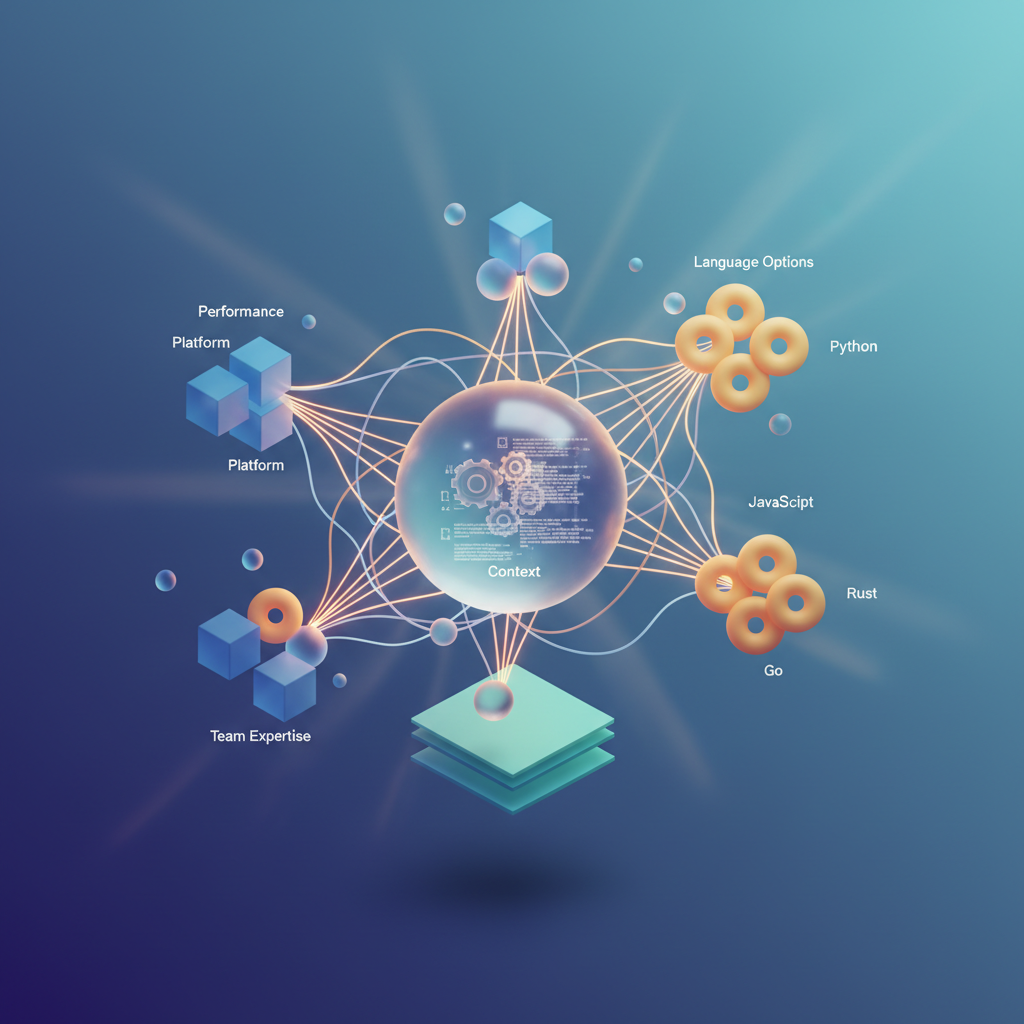
Decision Framework: Choosing Your Language Based on Constraints
The choice between Python and Go shouldn’t hinge on theoretical performance metrics. Instead, consider these practical constraints that dictate which language will deliver better outcomes for your specific situation.
Startup MVP vs Enterprise Migration
For greenfield MVPs with uncertain product-market fit, Python wins decisively. A three-person team can ship a Django-based product in weeks, validate assumptions, and pivot without rebuilding infrastructure. The cost of premature optimization far exceeds the cost of scaling later.
Go becomes compelling during growth phases. When you’re processing 50,000 requests per second and your AWS bill approaches six figures, rewriting critical paths in Go pays for itself in months. Pinterest rewrote their feed generation service from Python to Go and reduced server count by 75%. But they did this after reaching scale, not before.
Enterprise migrations follow different economics. Replacing a stable Python monolith requires justification beyond “Go is faster.” Valid triggers include: infrastructure costs exceeding two engineering salaries annually, existing team attrition creating knowledge gaps, or regulatory requirements demanding process isolation that containers can’t satisfy.
Team Size and Experience Thresholds
Teams under five engineers should bias toward Python unless building infrastructure tooling. The productivity multiplier of Django, FastAPI, and the Python ecosystem outweighs Go’s advantages at this scale. One senior engineer can maintain a Python service handling modest traffic indefinitely.
Between five and fifteen engineers, the equation shifts. Go’s explicit error handling and static typing reduce coordination overhead as team size increases. Code reviews become faster when the compiler enforces contracts. Onboarding junior engineers takes weeks instead of months when they can’t accidentally break production with runtime type errors.
Beyond fifteen engineers, Go’s operational simplicity compounds. Standardized tooling (gofmt, go modules) eliminates bikeshedding. Cross-team dependencies become easier to manage when every service compiles to a predictable binary with no runtime version conflicts.
💡 Pro Tip: The right answer often changes as your team grows. Budget for one major rewrite during your scaling journey rather than trying to predict the perfect initial choice.
Performance Requirements That Actually Matter
Most applications don’t need Go’s performance characteristics. An e-commerce checkout flow serving 100 requests per second runs identically on Python or Go from the user’s perspective. Network latency and database queries dominate response time.
Go becomes essential when you’re building: real-time bidding systems with sub-10ms latency budgets, API gateways handling 100,000+ requests per second, data processing pipelines consuming streams at gigabytes per second, or WebSocket servers maintaining 50,000+ concurrent connections per instance.
The Hybrid Approach
The most pragmatic teams run both. Use Python for rapid prototyping, admin tools, and business logic that changes frequently. Deploy Go for performance-critical data paths, infrastructure components, and services requiring predictable resource consumption. Stripe runs Python for their dashboard and developer tools but wrote their API edge layer in Go.
This approach requires investment in inter-service communication patterns and observability, but it optimizes for team productivity across different problem domains rather than forcing a single-language constraint that serves neither domain well.
Key Takeaways
- Choose Python when time-to-market and developer velocity are critical, your team knows Python, and your performance requirements are typical for I/O-bound backends
- Choose Go when you have legitimate concurrency requirements, need operational simplicity in deployment, or are building for long-term maintenance with large teams
- Evaluate your decision based on team composition, hiring timeline, and project lifecycle stage—not just language features or benchmark results
- Consider a hybrid approach: use Python for rapid prototyping and admin tools, Go for performance-critical microservices